By Griffin Larson-Erf, Staff Writer
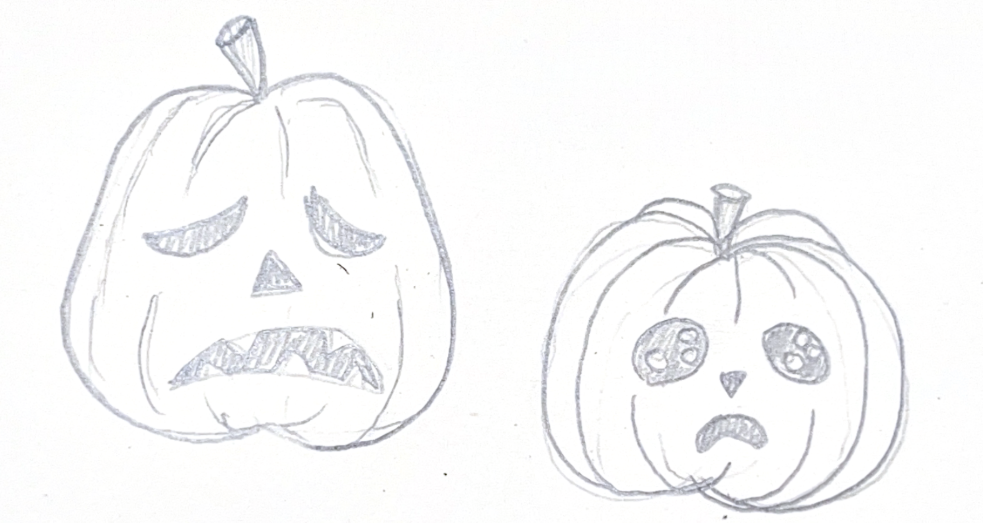
Illustration by Kaya Perelman, Contributor
Billy Sugarpie sat in a pool of his own rotten flesh and watched the trains go past. When I met him, it was an average Tuesday night, which meant Billy was waiting for the 9:45 to Petaluma, the biggest and the loudest of the trains in his routine. We sat in the grass-peppered mud of the Nantes Railway Depot and watched it together, the massive pistons rising and churning and knuckling under to rise again, all in the space of a second (if that), pistons ping-ponging, furious in their pursuit of another inch. Smoke flew from the smokestack in one belch after another, as millions of little pollutionary particles sped skyward, determined to do their duty. The Petaluma train let out a high, flute-like whistle, a kind of uproarious tipping of the hat to its lookers-on, and hustled down the track to brighter skies and greener pastures.
Billy Sugarpie is a pumpkin. This is the highlight of his life, now that Halloween is over. And he is not alone in his fate. As department stores pivot to Christmas aesthetics with the speed of that very same train to Petaluma, pumpkins have become an aberrance—leading most of their former owners to drop them in the first patch of dirt they can find.
In the regular spooky season, pumpkins are treated in much the same way as racing horses, cared for with an eye towards musculature and fitness for the task ahead of them. Billy thought he stood a chance: he’d had a healthy, nutrient-gourged childhood on an upstate farm, and he had stood in the autumn sun for weeks straight before the big day, tanning himself to just the right shade of orange. Halloween of 2026 had been the proudest moment of his life. As his narrow carved eyes watched the children pass, and saw their little eyes dart towards him and then nervously away, his zig-zagging smile curved underneath his pride.
And then, the morning after.
“I could feel it in my sinews,” Billy told me that night at the depot. His voice was raspy with the rotting of his vocal cords. “It was what I always imagined the worst human hangover would feel like. There was this all-pervading sense of uselessness, of lack of meaning. That big grin that was etched into my face felt foolish and heedless all of a sudden, but I couldn’t get rid of it. It was a terrible feeling.”
Billy’s owners kept him around for a few more days, more out of a lack of time to find a place to drop a pumpkin than out of any compassion. In that way, he was lucky. Robin Greatwhite was out on her ass while the sun was still rising on the after-hallows. She went from helming the porch of a woodland cabin to lying on her side in a puddle beneath a random tree.
“The worst thing, I’d have to say, is the disappointment in myself,” Greatwhite told this reporter. “I studied at Julliard Pumpkin University. I’ve had the greatest training one can get in nailing that spooky vibe that doesn’t go so far as to stop being family-friendly. I always felt like I was meant for big things. In the end, I’m just some friggin’ fertilizer.”
There are those, of course, who charge that Greatwhite’s and Surgarpie’s fates are exceptions, rather than the rule. A recent study by the Harvard Center for Random Curiosity found that about 40 percent of all pumpkins make after-Halloween income as plant-seed donors and surrogate fathers for future pumpkins. Some five percent become wellness gurus, using their journey of decomposition and return to the soil as the backbone of podcasts exhorting listeners to embrace change and let life take them where it takes them. Another two percent are adopted as pets by the stranger breed of tiny children. In 2025, the pumpkin community was particularly energized by the example of Seamus Sweet-Dumpling, a pumpkin who had been purchased but never carved by an avant-garde artist. When Halloween was over, his owner duct-taped Seamus to a wall at the Art Basel Miami Beach art fair and sold him for $6.2 million. Deep in their hearts, any pumpkin you meet likely harbors a dream of imitating Sweet-Dumpling and living out the rest of their days as an installment.
“Don’t let the dominant malaise fool you: there’s work to be had by pumpkins after Halloween,” said Bruce Butternut, president of the American Pumpkins’ Union, the nation’s largest pumpkin labor organization. “Here at APU, we’ve worked hard to expand post-season opportunities for our members. We’ve established partnerships with compost companies, to let our fellow gourds put their intimate experience with decomposition to use, as consultants and supervisors. We’ve worked with local beaches to get pumpkins employed as lifeguards—nobody can look into that rotting old face and say they’re not going to get out of the water. We have resources available for any pumpkin who’s fallen on hard times.”
But Billy Surgarpie says he tried for a year to take advantage of the APU’s resources. Whatever positions the union made available were furiously competitive; after a dozen fruitless applications, he gave up. He had already arrived at the train depot by that point, having rolled there from the top of the hill that his former owners threw him off of, and he decided that the rest of his days would be spent there, watching the trains go by.
“A wise person once said that you can’t live only for one thing,” Billy told me. “You can’t, because once it leaves you, you don’t have anything to hold onto.” He paused, and a single tear eked its path down his round, faded-orange cheek. “Nothing to hold onto. I never thought I’d have to learn about that the hard way.”