by Gram Griffioen, Contributor
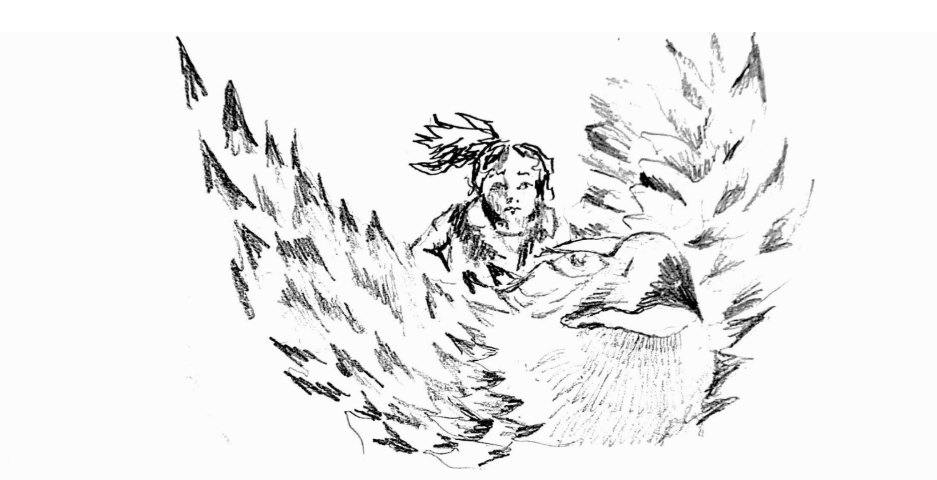
Illustration by Eila Duncan, Layout Assistant
As someone who enjoys both watching and creating stop motion animation, I have seen too many stop motion animated films to count. None of these films have even come close to inspiring the amount of awe and bewilderment that LAIKA Studios’ most recent film, Wildwood, did. The scale of what LAIKA has accomplished with stop motion is nearly incomprehensible. However, it begs the question: Is stop motion advancement really a good thing? Does Wildwood still have the same handmade, choppy, and cozy feeling that has defined stop motion for over a century?
In 2005, LAIKA became an official stop motion animation studio. Four years later, they released Coraline, which has since risen to global fame and become one of the most renowned stop motion films to date. Almost immediately after Coraline, LAIKA CEO Travis Knight began thinking about adapting Colin Meloy’s fantasy novel Wildwood into a stop motion film. But back in 2010, LAIKA did not have the stop motion techniques required to bring this wild adventure story to life. In Knight’s own words, “It was only after we had made five films that I thought we were ready to make Wildwood.”
Most stop motion animators tend to avoid animating particular things that are too difficult to pull off, if even possible at all. But LAIKA sees these challenges as opportunities. With each film after Coraline, LAIKA has been continuously pushing the limits of what is even possible to create in stop motion. The clearest example of this in Wildwood is the epic final battle scene. Hundreds of individual puppets run at each other and fight while fire balls are thrown around and explosions fill the screen. Later in the scene, a whole bunch of eagles fly through the air to fight a giant group of crows, all while a smaller battle occurs amongst a mass flailing vines and leaves. This is the kind of scene that would be extremely difficult to do in CGI animation, let alone stop motion. I cannot even begin to imagine how much effort it took to pull this sequence off, but I can guess that it took many months (if not over a year) just for this scene. For context, LAIKA operates at 24 frames-per-second, meaning that for every one second of animation, there are 24 individual frames. The stop motion part of Wildwood’s run-time is about two hours, which is equivalent to roughly 172,800 individual frames of animation (if my math is correct).
To me, what makes stop motion animation so magical is that you are able to look at any shot and tell that everything you are seeing was crafted by human hands. It creates a scrappy, down-to-earth feeling when the animation is slightly unrealistic and choppy and you can tell that a puppet’s fur is real. But LAIKA has made so many technical advancements that it is now extremely difficult to tell that their recent films like Wildwood are actually stop motion animation. If I had never heard of LAIKA, and somebody showed me a clip from Wildwood, I genuinely don’t think I’d be able to tell that it was stop motion. The movements are remarkably fluid, and the detail in the puppets and background sets is impeccable. It looks so good that it could easily be confused for the same CGI animation used by Disney and Pixar. And to me, the magic of stop motion is that it feels handmade; it feels like something you could actually reach out and touch with your hands.
Unfortunately, by making stop motion look too good, LAIKA has nearly lost that feeling. If their goal was to make stop motion look like CGI animation pretending to be stop motion, then what’s the point? Why not just make their films using CGI? I suppose Travis Knight would say that the point is to keep stop motion alive by continuing to advance it. But to me, these advancements take away from what makes stop motion truly magical: the feeling that what you’re watching was made entirely by human hands.
Now just to be clear, I’m not saying that you shouldn’t go watch Wildwood. You absolutely should. It is an incredibly beautiful film with a powerful, emotional story and some of the most visually stunning shots ever put forth by the stop motion animation industry. It is a work of art that will unfortunately never receive the amount of praise and attention that it undoubtedly deserves. Even though it may not feel as hand-made as other famous stop motion films like Fantastic Mr. Fox or The Nightmare Before Christmas, this doesn’t diminish from the incomprehensible amount of work that was put into this film. The fact remains that Wildwood is a full feature length animation that was brought to life by dozens of pairs of very skilled, and ridiculously patient human hands. To me, that’s more beautiful than any painting in a museum.
If this review didn’t convince you to go watch Wildwood, then perhaps your hatred of AI will. I cannot think of a better way to give generative AI a giant middle finger than to go watch one of the clearest examples of human creativity and ingenuity in recent years. As I am writing this, Wildwood has just begun screening at the Apollo. I know I will be going there to re-watch it very soon.