by Kate Weissenberger, Staff Writer
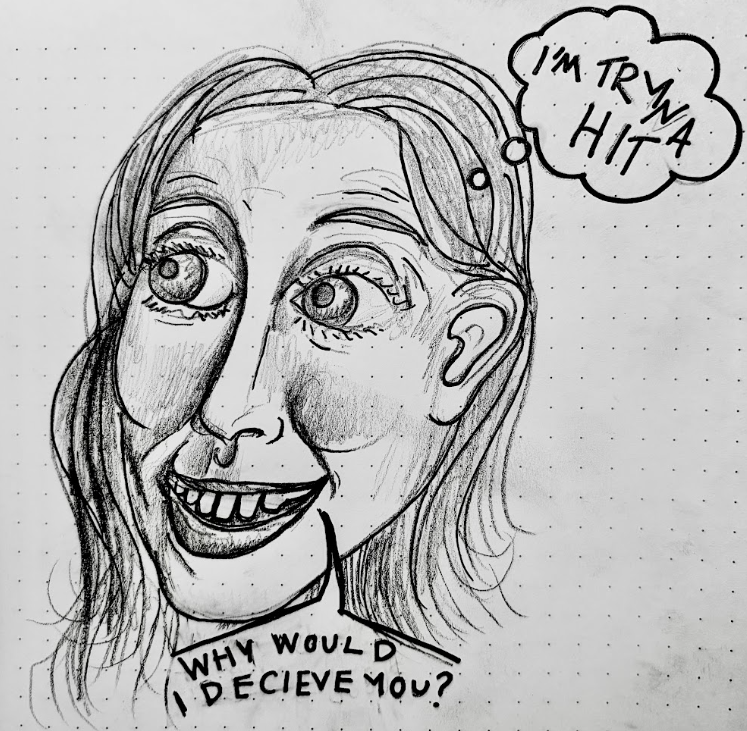
Illustration by Adi Horodniceanu, Contributor
I’ve written before about my disdain for our irony-poisoned supply of cultural fodder, but the widespread response to Nathan Fielder and Lance Oppenheim’s You Can See Everything has somehow managed to surpass my expectations for just how foolish we people can be.
I went to see You Can See Everything with my little sister (who had already seen the film once) over fall break. What little promotion of the film existed had passed me by, so I was really going off of nothing other than my desire to Do Something and my sister’s insistence that I would fuck with it. Even at ten at night on a Friday, our screening wasn’t exactly hopping—there were no more than seven other people in the theatre with us—so I got to focus entirely on the madness unfolding in front of me.
And it was utterly entrancing. When my jaw wasn’t ajar, I was biting my nails to stubs, wide-eyed and hunched over as though the few extra inches of closeness to the screen would afford me some greater understanding of Elizabeth Holmes’s mind. When the credits eventually began to roll and my knees stayed bunched to my chest, my sister had to tell me to “get out of that contemplative position” so we could go.
Since I left the theatre a little less than two weeks ago, I’ve been sitting with many of the same ideas about truth and power that I assume many viewers have. I still don’t know what to believe about Holmes; I’m still unnerved by the blatantly cruel and narcissistic behavior of Billy Evans; I’m still captivated by the one moment of conflict with Evans in which Fielder—seemingly the most lucid person on-screen at any given moment, though the competition isn’t exactly stiff—seems to drop his own mask for a moment. You Can See Everything was capable of kickstarting fascinating dialogues about everything from stereotypes of female incompetence to the politics of watching, and instead the conversation has devolved from parley to patter.
The game was over, I think, the moment the pivotal conversation between Fielder and Holmes (“Of course I’m not deceiving you. I’m engaging with you as a human being”) became a GIF. A reel is one thing; I’m no fan of short-form content, but there’s still an opportunity for some sort of brief commentary or analysis there. On the contrary, a GIF moves, but is ultimately static, doomed to reenactment—a bad-quality punchline in both form and content. From this blue-eyed bomb came an onslaught of activity purveyed by consumers and magnates alike.
It was the costumes themselves, sure, but it was also the New York Times’ article “Halloween Costume Ideas That Scream 2026” with its Fielder/Holmes entry, featuring—surprise!—the aforementioned GIF, along with the caption: “What you’ll need: Salt-and-pepper wig, blond wig, blue contact lenses, copious blush and an unwavering conviction that you did nothing wrong.” It was the lookalike contest in Washington Square Park and the reenactment from Kate McKinnon and Seth Meyers and the costumed skit from Jamie Lee Curtis and Jimmy Fallon and the jokes about an affair between Fielder and Holmes. It was the dismissal of Holmes and Evans as simply ridiculous when the reality of the situation is that these are people who held unimaginable amounts of wealth, who were in cahoots with some very powerful men—Henry Kissinger was on the board of Theranos, for Christ’s sake—and who got to decide, to some extent, what and how the population at large would think.
You Can See Everything asked us what truth is, and we responded unable to take ourselves seriously, much less the documentary. It’s unrealistic to act as though the public’s reaction to Fielder’s work is just good, harmless fun when the evidence for the effectiveness of mass desensitization of the public through memetic means continues to abound. When we make caricatures of Fielder, Holmes, and Evans, we fail to recognize that the greater patterns of power and control displayed in every sphere of life, from the home to healthcare to hedge funds, are designed by real, flesh-and-blood people, who, uncanny as they may be, are operating neither by the word of God nor Lorne Michaels.
I do wonder how much of a role the lack of crowd-wide reactions during my screening has played in the development of the place I feel I occupy in the culture surrounding You Can See Everything. Would I find more pleasure in the couples’ costumes had there been a big swell of laughter when Fielder offers to go lock himself in his car to give Evans and Holmes some time alone? Would I find Billy to be more bumbling and brash than deeply disturbing had a crowd groaned comedically when he defended Charlie Kirk?
I’m obviously not separate from participation in these cultural movements, nor am I above it; I caught myself using the documentary as absent-minded small talk more times than I’d like to admit. The best method for remediation, I think, is to be conscious of not only the media we are consuming, but the environment in which it is being consumed. Documentary is a powerful tool, but it still filters reality—no matter who’s backing it financially. The growing distance between ourselves and our ability to critically analyze media in combination with social media’s breakdown of the separation of idol and fan points to a disturbing trend in our inability to take modern media as a whole seriously.
You Can See Everything is not the first instigator of such post-ironic idiocy, but I think it’ll be remembered for the reactions it instigated; the possibility of it acting as inspiration is also certainly real. Whether we will have grown past our absentminded giggles by the time those derivations release is hard to say. If we are to do so, though, it’ll require us to step back and confront just how terrifying the world at large is right now, rather than distracting ourselves with our own personal circuses 24/7. Maybe we can never see everything, but we can at the very least do our best to pay attention to what’s going on around us.