Apotheosis of June Leaf
by Oliver Seaman, Contributor
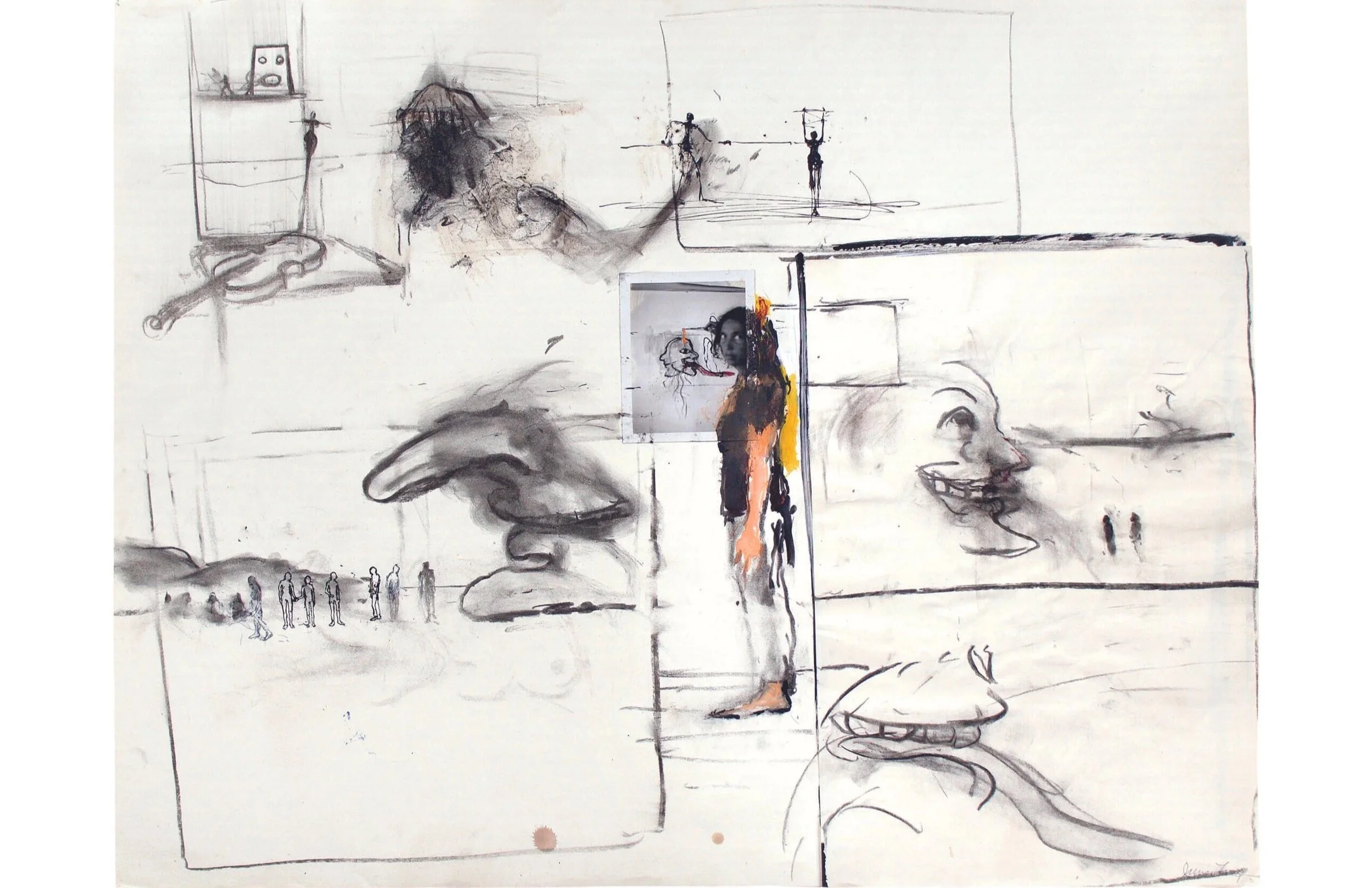
We are in the midst of an obnoxious pickle. We are supposed to love money, but each of us has gifts which we can grant, free of charge, to others and to our environment. I am a painting guy myself and I spent several hours at the Allen Memorial Art Museum's June Leaf show, and I think it is pretty damn neat. Why so? Let's consider!
Leaf's work in this show spans from the 1950s to the 2010s. She was a native of Chicago and studied there, migrated to New York at thirty, and within ten years was a very successful artist.Later, Leaf moved from the city to Nova Scotia and resided there for the rest of her life. Indeed, my initial scanning of the exhibition's first room, focused on her urban period, reminded me of rotten apples. Arcade Women, a painting from 1956, opens with a parade of reds and yellows affixed to a group of seated women with big hats that take the place of their faces. Black and gray force lines run through the composition like a grid but don't seem to order the space they intervene in; the women are stale and dumb, and external lines are trying to make them energetic. It is a fascinating, complicated composition, but this early attempt at space-construction comes out choking and inactive. Marat Side Bedroom, from ten years later, depicts a hotel lobby. The painting keeps the bold color and doubles down on the messiness; space is made out of twisting paint and the pillars holding the hotel up are unstraight and outlined in seeping reds. Humans are seen from the front, often without clothing, a woman whose body sags on a carousel-horse, but whose arms are exultant with two American flags in her hands. In a manner akin to German expressionists, Leaf discovers a way of treating the modern city as the product of people who are not any different from the spaces around them. She incorporates elements of pop into her art in 42nd Street (1964), decorating the smudgy buildings with pages taken out of comic books. This kind of rhythmic, mannered glut of human beings strikes me as a genuine evocation of the cramped, busy urban space. She accomplishes this with charcoal-like outlines and incompletely blended volumes of figures. Her Vermeer-based deep-spaced version of a Cornell box is also good; it is gaudy without cleanliness.
The city-based action of Leaf's career seems to culminate in The Ascension of Pig Lady, a diorama with a mix of painted and sewn-sculpted figures on, in front of, and over a nocturnal city canvas. I get a sense of narrative without having any idea of what's going on. The figures have broken out of the window of the 'picture', and now June Leaf can be a sculptor. What's missing from Leaf's early work is any idea of her human figures as individual people who have dumb stuff like “psychology” in their heads. People are moving around the city, and as such, they are defined by the city. In this sense, Leaf is unburdening the urban individual from 'psychological' bonds, certain ideas of agency that, no matter their truth, tend to slacken our sense of duty towards each other.
Moving out of New York forced Leaf to change her subject matter; she lost access to the cityscape, But, by doing so, she gained access to nature. On my first visit to the show, I was amazed at how dramatically her paintings seemed to change once I entered the second gallery. Her color palette is mostly stripped of red and yellow and becomes dominated by black, orange, pale blue, and white. The negative space of white background becomes important to her work. Paint is thick, like dried clay. There are a lot of works here, but Mother Goose (1976), one of the many small drawings done on paper, caught my eye because of its charged black-and-white composition, spare, strategic usage of collage, and bright colors. To Create Life out of Life (1972), is more colorful and collage-y, and chronicles her observations of biological science. It is playful and chaotic and multi-layered, reminiscent of the work of Robert Rauschenberg and John Marin.
The Mooring (1979) is a painting of the head of a woman in dark gray with a huge circular tumor behind it, surrounded by a windswept landscape and a bright blue sky. She breathes sludge-fire. This motif appears again in The Head (1980-81), an aluminum sculpture of the same woman. In the sculpture she is earless, eyeless, and her tumor is weightless, full of holes. Leaf was inspired by the feminist movement to create sculptures of female forms, but I wouldn't necessarily call them 'women'. The Head is archaic, and looks like it comes from the Minoans, not from the mind of a modern artist. Angel on Treadle, from 1989-90, feels old but in a different way; her head and arms are made of tinfoil, her legs are made of steel, her chest is made of beams and a support-structure, a purposely unfinished sculpture with wires flinging around. Leaf doesn't just minimize the individual in the crowd, she minimizes them relative to their own body, which is now made up of steel parts and paint. The deeper into the galleries you get, Leaf's work, which is fun from the start, seems ever more complex and wiry. The Giacometti-sculptures of flaky, existential figures ascending spiral rails are brilliant. June Leaf turns herself into a figurative artist, dons an expressionist cape, and in her very best work, she channels a seething energy into pictorial and sculptural units.