by Henry Boehm, Staff Writer
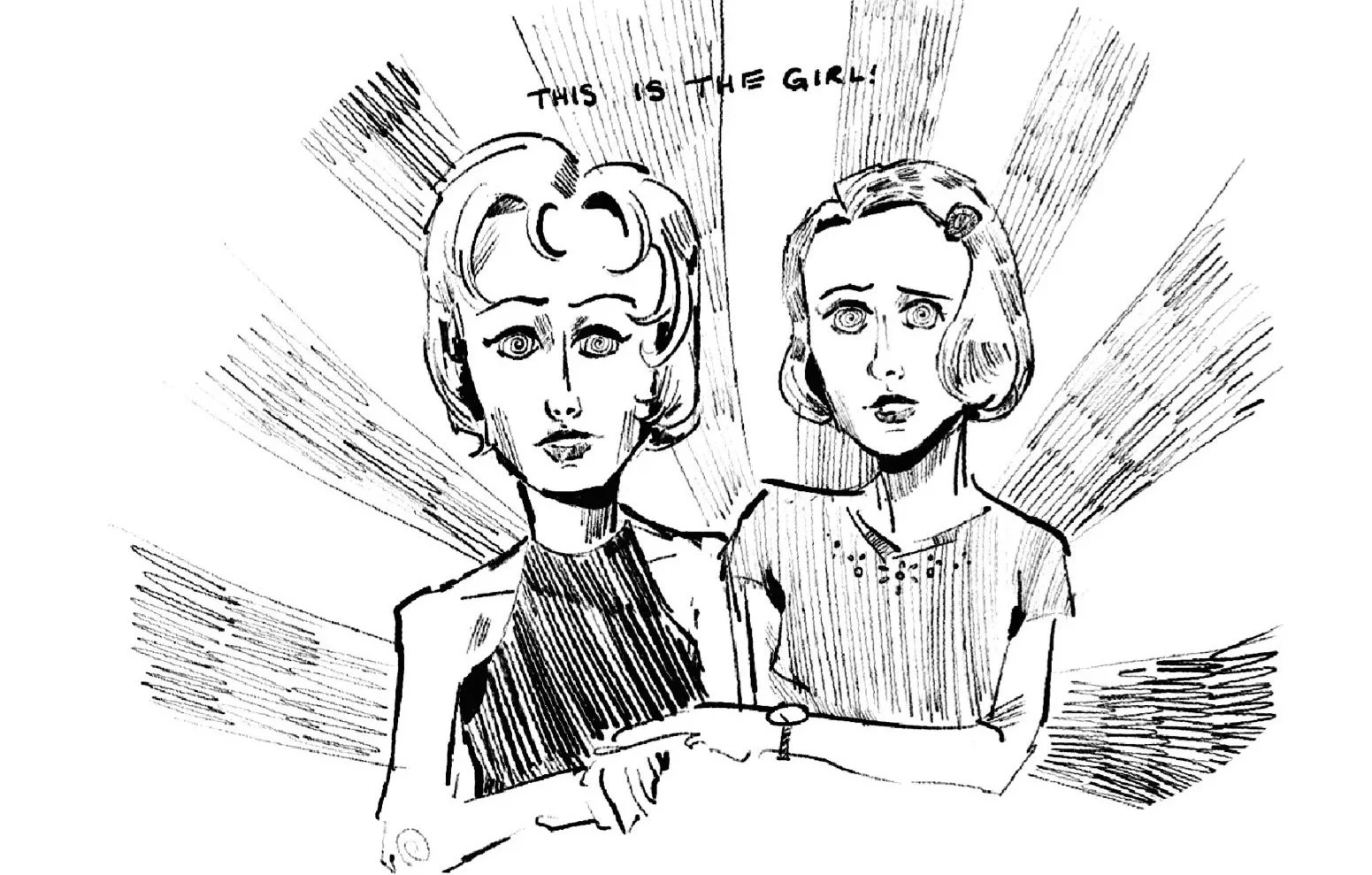
Illustration by Molly Posey, Contributor
I’m not really a movie guy. It’s a fact I’m reminded of every time my three movie guy roommates begin talking shop (if I had a nickel for every time I’ve heard the word “anamorphic”…), or, god forbid, start playing Cine2Nerdle, a competitive movie trivia game, against each other (I can’t even make an account! Give me a chance to prove myself, Cine2Nerdle!). I’ve had many a car ride back from the movie theater where I struggled to muster up a remark as insightful as anything my friends were saying. I’d try my best (“[Actor] was great” or “The whole movie just LOOKED really good” were two of my go-tos: use with caution), but I couldn’t shake the feeling that I just didn’t “get it.” What was I supposed to have taken away from that experience? Surely I didn’t spend 20 dollars just to gorge myself on popcorn and Pepsi in the dark for two and a half hours? What were the themes, God dammit? What were the themes!
In many ways, Mulholland Drive is the ur-ungettable movie. The narrative, if one can even be said to exist, is basically incomprehensible. Weird, clichéd dialogue, aimless sublots, abrupt tonal shifts, out-of-place vignettes with one-off characters—it’s a movie you walk out of feeling disoriented at best and pissed off at worst. And, of course, when we enter Club Silencio at the end of the second act, everything is turned on its head. There are several points where you feel like you understand what type of movie this is going to be—a romance, a detective thriller, a mafia movie, even—but then the next scene starts and you’re back to square one. It’s like the whole thing was purposefully made to be impossible to follow.
I was introduced to Mulholland Drive in my very first semester at Oberlin by my dear friend Catherine Gilligan, the editor of this very article. My friends and I watched it in the now-defunct Fairchild House. It was utterly captivating, even on that awful, blurry TV screen in that shabby common room. My friends and I talked it over for what felt like hours, trying to piece everything together with the help of a list of 10 clues David Lynch provided on the original DVD release (how fun!). After much deliberation, we developed a theory to explain the movie: Basically, part of the movie was a dream, and the other part was reality. Simple! No loose ends, everything neatly explained away. Such theories are perhaps one reason why Mulholland Drive was Lynch’s most critically acclaimed film upon release: Many critics viewed it as a “puzzle-box film” whose disparate narrative is a riddle which can be “solved” to reveal a coherent story with definitive answers.
Needless to say, our theory did not hold up on rewatch. The truth is, there is simply no way to definitively “explain” the film, to fit every piece into a logical, consistent structure. No theory, no matter how convoluted, can satisfyingly grasp every vignette, every bizarre side character, every uncanny line delivery. The film will always remain inherently fragmented, illogical, dreamlike. A simplifying theory can serve as something to grasp onto if you’re completely lost, but, at the end of the day, you’ll find that the beauty of Mulholland Drive comes from what you don’t quite understand.
For me, the key to “getting” Mulholland Drive was realizing that the core of Lynch’s surrealism is emotional. The movie isn’t a puzzle—it’s a story, like all other movies. Once you give up trying to make rational sense of everything, you’ll find a clear emotional throughline that runs through the entire movie. Understanding every plot intricacy is simply not necessary to follow this throughline—you don’t need to be a genius to experience the unreal terror of a waking nightmare in the Winkie’s Diner scene, or to feel the bitter mixture of humiliation and jealousy on Naomi Watt’s face as she watches the woman she loves giggingly reveal her engagement to another man, like an inside joke she’s been left out of. This doesn’t just apply to Mulholland Drive—for most movies, the story is right there on the characters’ faces.