Nationalisms collide at TPUSA Halftime Show
by Henry Boehm, Contributor
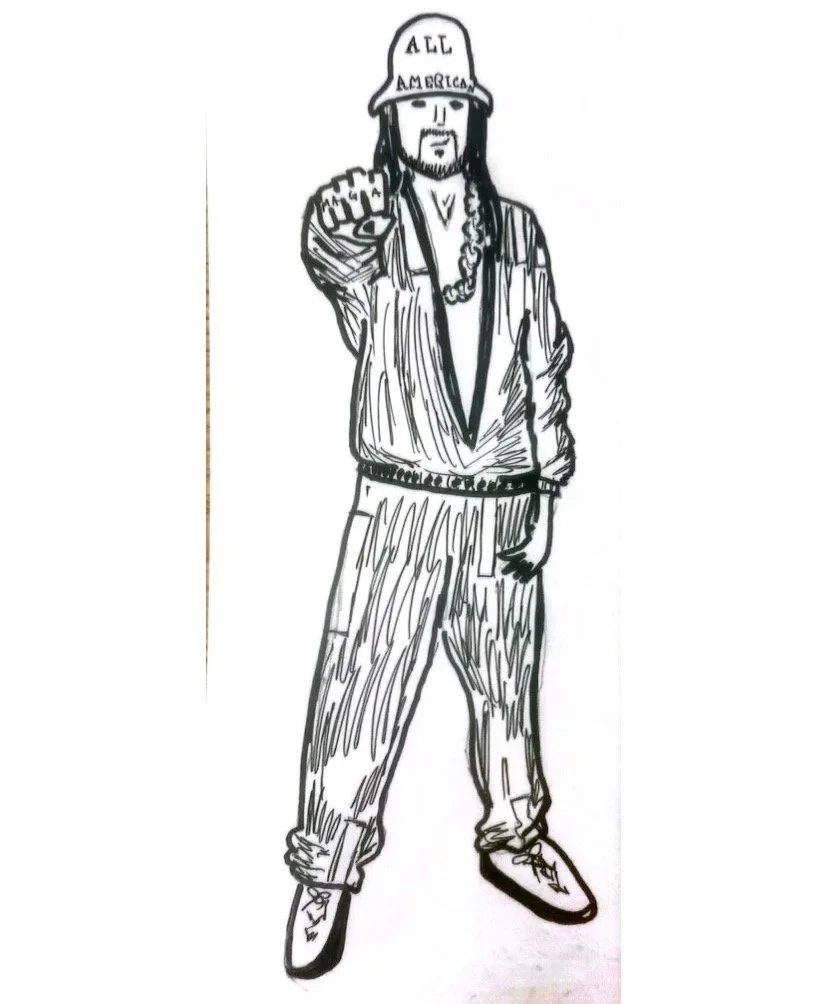
Illustration by Emma Shoaf, Production Assistant
Kid Rock is back, and he’s shittier than ever. I almost feel bad for the guy—being the hottest pop star of Chud America can’t be easy, and Kid is looking a little worse for the wear. Recently, he had the honor of headlining the “All-American Halftime Show” organized by Turning Point USA, which was livestreamed on February at the same time as the Super Bowl LX halftime show. Even before the event, Kid Rock faced controversy after online sleuths unearthed his 2001 song “Cool, Daddy Cool”, which features the lyrics: “Young ladies, young ladies, I like ’em underage see / Some say that's statutory / But I say it's mandatory!” Ouch. TPUSA organized the All-American Halftime Show due to conservative resentment surrounding the fact that Bad Bunny, a Puerto Rican rapper who mostly performs in Spanish, was set to headline the Super Bowl LX halftime show. But why the controversy? Puerto Ricans are American citizens, and over 40 million Americans, roughly 13% of the population, speak Spanish at home. Based on the 2020 census numbers alone, we should expect a Spanish-language halftime show every eight years (and a Chinese halftime show every 100 years, in case you’re curious). And since all of the 59 halftime shows before this have been almost exclusively in English, it seems we’re overdue. So, what’s the deal? Why do conservatives care so much about the Super Bowl halftime show in the first place?
It should go without saying that the Super Bowl is more than just a sporting event. It has enormous cultural and economic significance that reaches far beyond American football itself. Crucially, it is a ritual that annually reaffirms American nationalism—the idea that there is such a thing as “Americans” who are united together in a national community by virtue of shared identity, history, and traditions. One such tradition is American football, America’s undisputed national sport (sorry, baseball—those uniforms are a little too cute). Sports are an integral part of nation building—think about how seriously people take national soccer rivalries in basically every other country on Earth. Major sporting events become a potent vehicle to reinforce national unity and pride, usually in conjunction with other national symbols—the fact that every Super Bowl opens with a rendition of the national anthem, for instance—all designed to get that patriotic blood flowing.
Given this context, it’s easy to see how the Super Bowl halftime show can be politically contentious. TPUSA’s protest against the Super Bowl LX halftime show isn’t about hating reggaeton (though they definitely do). It’s about controlling the narrative—being able to define who counts as American, and who doesn’t. Regarding the Bad Bunny controversy specifically, it’s useful to distinguish between two types of nationalism that you might remember from high school social studies (or from college sociology classes if you’re built like that). The first is civic nationalism, which grounds national identity in citizenship and shared liberal democratic values. It is typically characterized as the “good” nationalism—think American citizenship law, which cannot legally discriminate on the basis of race, religion, or national origin. The second is ethnic nationalism, which grounds national identity in ethnicity, defined by shared characteristics such as language, religion, and heritage. It is often characterized as the “bad” nationalism—for an extreme example, think Nazi Germany, which limited citizenship and political rights to ethnic Germans and explicitly excluded other ethnicities such as Jews, Poles, and Roma. These types of nationalism are typically thought of as separate and in firm opposition to each other.
The Super Bowl halftime show, then, articulated a civic nationalist narrative of the American nation: Bad Bunny, and by extension all Hispanic and Latino residents of the United States, are Americans. Being Puerto Rican or a native Spanish speaker is irrelevant to their place in the American nation as long as they accept the liberal values of the U.S. constitution. The All-American Halftime Show put forward an ethnic nationalist response: Bad Bunny is not an American because real Americans are white and speak English—and sure as hell aren’t Puerto Rican, citizen or not. But the fact that these two performances happened simultaneously reveals that civic and ethnic nationalism cannot be thought of as totally separate. Rather, they’re two sides of the same coin. Even if federal law claims that anyone can be an American, if you close their eyes and picture an “American,” most people will imagine someone who is white, Christian (likely Protestant), and a native English speaker. Try as you might, it’s impossible to erase this image through legislation alone. To think so would be to subscribe to the naive, conservative fallacy that racism no longer exists since being made illegal during the Civil Rights era. Though illegal, systemic racism remains endemic in all aspects of American society, along with ethnic nationalist currents have always lurked just beneath the surface.
These racist narratives which shape American national identity have remained unspoken for decades, since the Civil Rights movement rendered explicitly discriminatory rhetoric politically taboo. But that does not mean they disappeared. Especially since the beginning of the Trump era, these taboos have begun to fall by the wayside as the uglier side of American nationalism now openly rears its head again. When Trump signs an executive order designating English the official language, or the Supreme Court legally sanctions racial profiling by ICE, or TPUSA declares a halftime show featuring a Spanish-speaking Puerto Rican rapper “un-American,” they’re saying the quiet part out loud.