Marty Supreme’s Intricate World, Beneath the Surface
by Violeta Gonzalez, Contributor
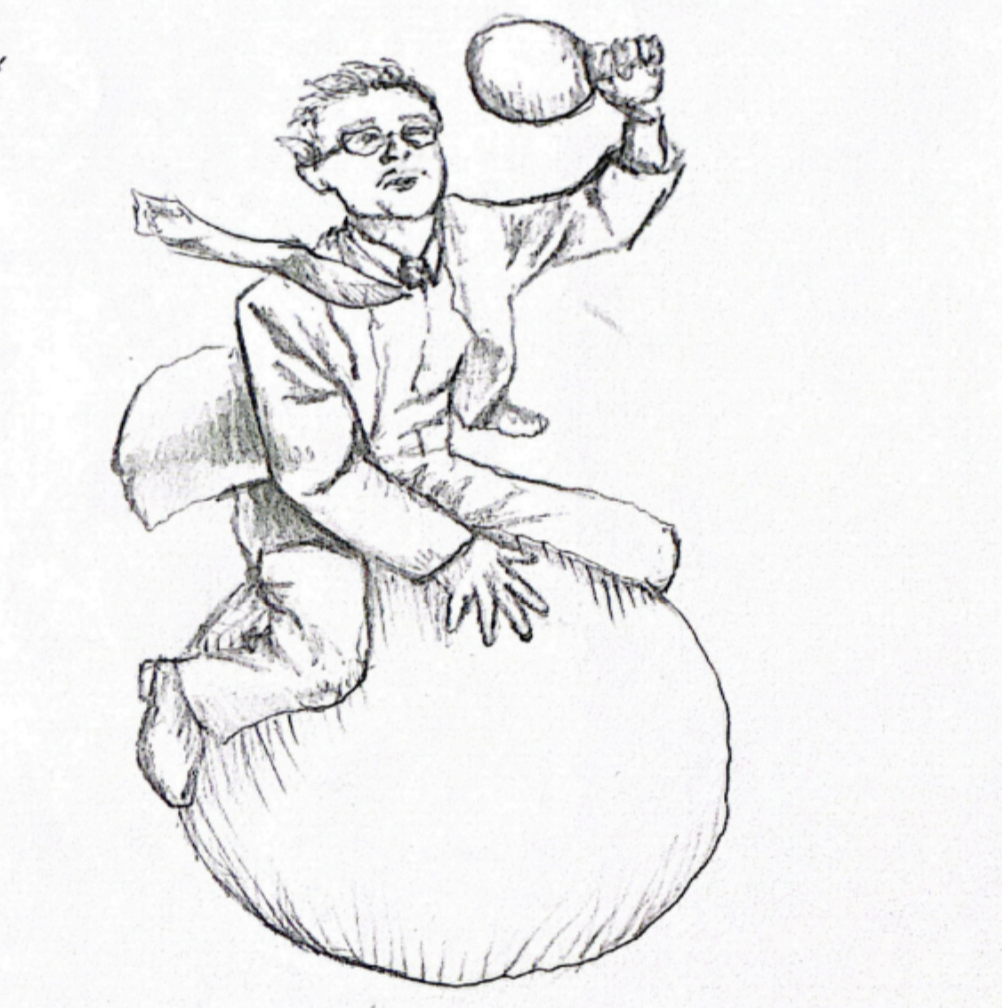
Illustration by Eila Duncan, Layout Editor
I spent most of 2025 looking forward to Josh Safdie’s Marty Supreme after spotting a promotional poster on my way out of a movie showing early in the year. Perhaps it speaks to the film’s inherent magnetism that it had managed to capture my interest when I scarcely knew anything about it; the premise of a ping-pong movie starring Timothée Chalamet—who had recently tickled me via his A Complete Unknown press escapades—felt right up my alley.
Of course, anyone who’s watched Marty knows there’s much less table tennis than one might expect, especially considering its titular protagonist’s incessant drive to become the greatest player in the world. I watched the film on Christmas—release day—and, once it finished, I didn’t dwell on the subject of ping-pong very much when turning what I’d just seen over in my head.
Marty is deceptive. It’s easy to take at face value; a cursory glance may present Marty as a toxically masculine hero who, after pulling those around him down to propel himself upwards, finds his egocentrism vindicated in a victory that coincides with the birth of his son and consequent establishment of his lineage. A chauvinistic tale likely, perhaps, to attract a similarly-minded audience.
With his Star of David perpetually glinting off his chest, Marty’s Jewishness exists at the forefront of most of the film’s discussions of postwar geopolitics, religious identity, and life as part of a cultural diaspora. It’s a work of contrasts: Marty, American, in contrast to Endo, Japanese; Marty, an American Jew, in contrast to Béla, a European Jew; Marty, Jewish, in contrast to America, decidedly less so. Never outwardly discussed, but almost stiflingly present regardless.
The devastation of the Holocaust exacerbated an already-existing difference in the lived experiences of American Jewish people and European Jewish people. To American Marty, his ethnic identity is one he continuously struggles to understand his relationship with as a young adult; to Hungarian Béla, as to every imprisoned Jewish person, for many years it was his first and only defining characteristic. Marty retains the freedom to identify himself to others as he wishes, but Béla, permanently branded with a reminder of his time imprisoned in Auschwitz, does not possess this privilege. In essence, Marty retains the freedom to choose who he wants to be. But how to navigate a world that had organized one of the largest systemic killings of a people in history—second only to the Atlantic slave trade—less than a decade prior? How to navigate this as an American Jewish person, distanced physically and psychically from those of shared faith overseas?
Marty’s ambition represents something grander, a broader American dream: to be successful, to escape marginalization, to become affluent. He spends the film’s two-and-a-half-hour runtime pursuing this goal to a perverse degree—lying, cheating, stealing, embezzling, and prostituting himself to achieve it—and, in the end, succeeds in only a partial victory. He beats Endo and becomes the best table tennis player in the world at a tiny exhibition entirely divorced from the world championship set to occur the following week and the tide of interest that will accompany it. The script’s portrait of the way he looks on at his crowd is telling: “His eyes slowly glaze over, as if his life’s dream is being washed off his face in real time.”
It’s a degrading process, not an empowering one. With the loss of his ambition, Marty loses his sense of self. He, clearly devout, spent his youth hearing stories of Jewish perseverance and later excellence—in Nazi-occupied Europe, in the ancient Middle East (as per common misconception)—but isn’t able to accomplish that for himself. Rather, he succeeds in acquiring a baseline of the stereotypical American dream: starting a family.
I seem to have taken the film’s ending much more nihilistically than many. I do believe that Marty loves his son; the tears he sheds in Safdie’s final shot are certainly imbued in large part with joy and love. Nevertheless, there’s a defeated acceptance in them. Ultimately, he will never be able to pay off his fine to the International Table Tennis Association if he has a family to support. He will never play his sport professionally again. With the baby comes unconditional love—a chance to repair the relationships with his loved ones that have become strained as a result of his egocentric worldview and the decisions he makes as a result of it—but also the death of his true dream, his personal American dream. Marty will mature at the cost of his pursuit of greatness, thereby fulfilling Rockwell's prophecy that he will never truly be happy.
Interestingly, he and Endo only play two full sets in their final exhibition; Marty wins the game, but ultimately loses the symbolic match. In the end it is his inflated sense of self-importance that does him in, not his ambition.
I paint a cynical picture, but I took the movie to be poignant as a whole. Marty’s narcissism continuously leads him into a series of escalating (and entirely avoidable) predicaments, but his baby-shaped reality check forces him to reevaluate the way he treats the people in his life—whom, it was clear to me, he does genuinely love.
Marty Supreme was a masterclass all around, and its neverending string of surprises made for one of the best theater experiences I’ve had in quite a while. Seven weeks later, I still feel as though I have plenty left to unpack. As an experience, Marty is fundamentally exciting, inspiring, and motivational; after all, it has implored its viewers since the beginning—above all else—to dream big. But, as it seems, maybe not too big.