“Backrooms” Is Probably the Best Internet Horror Movie We’ll Ever Get
by Delphine McGee, Contributor
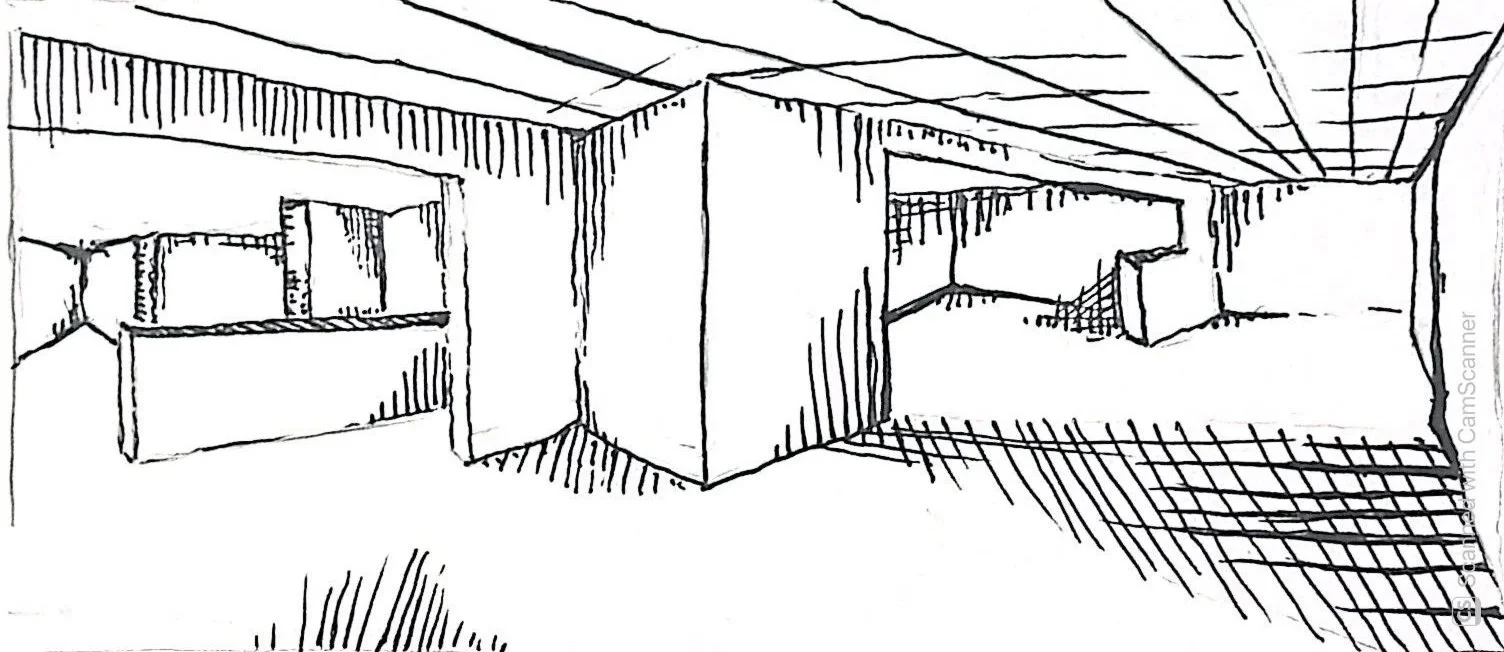
Illustration by Eila Duncan, Layout Assistant
As is the expansive, communal, and ever-changing realm of Internet horror, YouTuber and director Kane Parsons (did you know he’s only 20??) had a vast spectrum of expectations to manage. His debut film, Backrooms, is the feature-length outcome of what started as a 2018 post on 4chan. The largest point of contention among fans was the specificity of Parsons’ interpretation of the backrooms—was he going to cram an extensive amount of lore into the movie, or create an entire catalogue of spooky creatures similar to the SCP Foundation? Or was he going to keep the horror as nonspecific as possible? I was secretly hoping for the second option–to me, the most terrifying thing about the backrooms is their inscrutability.
Parsons manages to bring together both iterations of the initial concept. There are tangible, living threats in the form of the “Still Lifes” that roam the backrooms, and while their origins and functions are not exactly clear, they’re more comprehensible than the (physically impossible and presumably infinite) labyrinth they live in. Interspersed with what concrete knowledge the characters and audience have is an overwhelming sense of horror at the vast, uncanny absurdity of the backrooms themselves, which I think is what this specific strain of Internet horror is all about.
Analog horror became oversaturated almost overnight. Dozens of new series had cropped up on YouTube just a few months after The Mandela Catalogue exploded in popularity halfway through 2021–but most of them weren’t doing anything new or interesting with the medium, instead falling back on the trope of “alternates” (evil, alien doppelgangers who seek to psychologically terrorize the human race) that Mandela popularized. My problem isn’t with this trope specifically (Local58 uses it to great effect in their short film Contingency), but rather with how it was amalgamated into another easily definable horror archetype. The “alternates” quickly became as standard as vampires, zombies, and werewolves, cutting out much of the mystery which initially drew so many people to the genre in the process.
Some people maintain that the concept of analog horror was derivative and frivolous from the start, but I disagree. The series which defined the genre before it gained mainstream popularity use the unique medium of YouTube videos to display impressive levels of technical craftsmanship and invoke genuine, bone-chilling terror in millions of viewers. Local58, The Walten Files, Gemini Home Entertainment, The Tangi Virus, and Parson’s original backrooms short films on YouTube all defined the genre that, if Hollywood is to be believed, is soon to reshape the horror movie industry.
This summer, the trifecta of Backrooms, Obsession, and Iron Lung formed the basis for a new body of discourse regarding the future of the horror industry. Large studios have already bought out a number of intellectual properties: Siren Head, The Mandela Catalogue, and Jeff the Killer are all slated to get their own feature films. Producers for the first two projects intend to have the original creators and fans be (mostly) in charge of the direction they take.
In theory, this sounds like an innovative creation process, one with the sole purpose of recreating the same collaborative webs of fans which had made expansive catalogues of lore even before having a studio-backed creative team who could bring their ideas to life. But I have my doubts as to how this will actually play out. Fans were already split on how Parsons interpreted backrooms lore into his film—the debates that took place on the related subreddits in the weeks after the film released were heated. Some derided the Still Lifes as proof of Parsons’ catering to the cohort of fans who insist on creating specific taxonomies and lore for every horror concept they encounter, while others maintained that the malformed doppelgangers were the best part of the film.
Does our generation’s horror industry need a cohort of young, Internet-savvy directors who are able to transform the non-narrative concepts of video games and online horror into feature-length films? Maybe—but I have a sinking feeling that Backrooms marked the peak of this new subgenre. Personally, I can’t wait to have my Instagram feed flooded with Siren Head thirst traps once the movie is released.