Jazz Parties: The Great Equalizer
by Zoe Brunk, Staff Writer
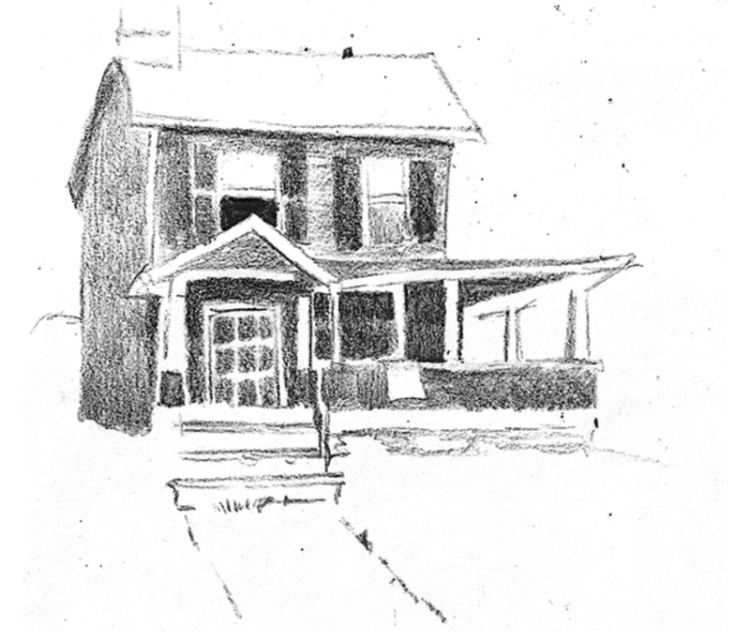
Illustration by Amit Eisenstein, Opinions Editor
Sitting at my Woodlands dining table, I feel the faint pulse of music. A strangely familiar song, I creep into my bedroom to catch the sound. My bedroom window lets the trickle of music through; across the way, I see crowds of people have formed, many heads bobbing to Beyoncé. “Love on Top.” I could easily imagine being down there at this moment, as this is a song that had been played at countless other jazz parties in my history at Oberlin. My friend, I knew, was somewhere in the crowd, though just a few hours prior she was renouncing jazz parties. What drew her in?
I have my own sticky, tired memories of the jazz parties of yore. The first was probably the best, though my freshman friends and I hadn’t discovered Johnny’s yet and were drinking the 20% vodka from Mickey Mart, confused about why it tasted like water and froze when you left it in the freezer. We were so little, walking up to a big house on a mysterious side of campus, which I now realize was a house on Union, hearing jazz pop reverberate into the front yard. We pushed our way in, excited to hear the main girl singing the intro to “Into You” by Ariana Grande. We bounced around; I was still unfamiliar with the concept of dancing while pressed up against walls of people. It got hot, and more feet sidled next to my own. I began to feel aware of the air that came in through the windows every time there was a slight breeze, and of the sweat that made the hairs on my head lie flat on the back of my neck. We left and were thankful for the Decafe mochi in our Dascomb freezer, and jittery about the fact that we had friends to walk home with.
Our next jazz party, I had the almost opposite experience. It was a rainy night, and when we arrived, we saw that fateful mountain of shoes by the door. This could only mean one thing; ours, too, would have to go. We slipped them off, awkwardly perching on walls and banisters and each other’s shoulders, and tiptoed up the stairs. That jazz party felt like a strangely liminal space. There was too much air there; the room was too big, and each group of people formed a planet-like center that orbited around the others, not making contact with the other solar systems, carefully aware of each other’s unprotected feet.
There was a jazz party where I was crushed after seeing the guy I was hooking up with leave with some other girl. There was a jazz party that happened outside, where unfortunately, I realized that the more space there is to dance, the less people want to. There was a jazz party where it was too quiet. There was a jazz party in a basement.
I began to stop expecting the music to change. Who were these jazz musicians, playing the same songs every time? It began to feel like everything was fake. It was a jazz party simulation. I was jarred when I heard the same music emanating from the jazz party this year. How was it that nothing had changed since my very first jazz party? What is it about jazz parties that keeps drawing people in?
Perhaps people enjoy the predictability of these parties. It will be the same music, roughly the same groups of people, the same overall vibe. Maybe jazz partiers are curious about what will be different this time, or the next, or the next. What change will occur in this controlled environment?
Presumably, OSCA’s finest will be there, peppering the crowd; Con students will support their fellow musicians, perhaps lending gear; sports boys will be in and out, frat-flicking in the back along to Beyoncé. And this is, I think, the most interesting part about the jazz party; this is one of the only times ever you can see all of these people in the same place.
This leads me to wonder: jazz parties-the great equalizer? Oberlin College is a school that attracts a diverse range of people. In a school full of Froot Loops, “Yeomen” are the Cheerios. The school is filled with students who want to be different: writers, radio show creators, musicians, people determined to have some kind of original voice. There is a pocket of the student population, however, that represents unoriginality. Students widely come to Oberlin not interested in the constructs of Greek life, and “Yeoberlin” is the closest thing found here that represents a fraternity. I’m sure that this separation is felt on both ends.
So what makes jazz parties so inviting to all students? Possibly, it is because they are thrown on common ground, often at an off-campus house, and their happening is widely spread around campus. Sometimes, all you need is to feel invited. Everyone is welcome, from sports boys to the OSCA president, creating a party makeup that is unique to these particular events. The music could have something to do with this, too. Maybe everyone is looking for some kind of regularity, and this music at jazz parties promises a scene they can predict. Possibly, everyone is searching for a little nostalgia, as the playlist personally reminds me of my middle school dances. In any case, Jazz parties provide a little predictability in an unpredictable world.