ICE Under Every Administration
by Erris Maguire, Contributor
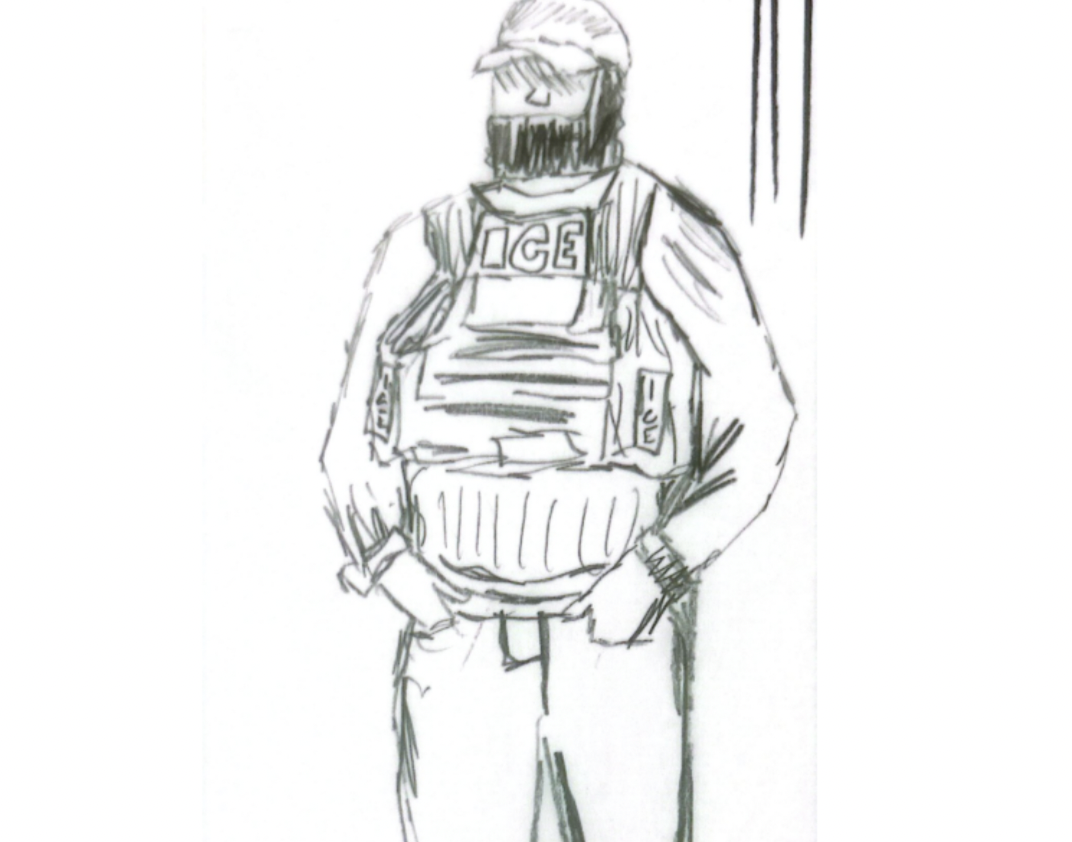
Illustration by Emma Shoaf, Layout Assistant
Documenting ICE in Chicago and the broader Midwest for Winter Term was a challenging experience, both because of the gravity of the topic and because of the emotional toll it took on my neighbors, friends, and community organizers. I met with exhausted, emotionally spent activists and lawyers who shortly thereafter travelled to Minneapolis to show their support for victims of ICE’s murder of Renee Nicole Good and Alex Pretti.
I learned that ICE existed in 2015, when I signed up for a Twitter account and followed all the activists my Dad followed (I do not recommend unlimited internet access for children). The men wore black gear, not the green camo they wear now, with black helmets with plastic visors. Importantly, their faces were visible, as opposed to their being masked now. ICE was printed across their chests. In this particular video I had seen, they were dragging an older Latino man out of his home. Screams could be heard behind the camera. The caption warned, “ICE on ____ street”— I can’t recall the name. I’m not sure if this video even exists on the internet anymore, but it has stuck with me.
I recount this not to segue into an “I knew about this before it made headlines” comment, but to draw to our attention the sheer scope of ICE, how long they have been doing what they are doing, and to ask: why are we only seeing national outrage about it now? Such widescale protests, boycotts, and civil action certainly weren’t taken up to this scale in 2011, when Obama had been setting records with arrest rates, or in 2003, when ICE itself was actually formed in a post-9/11 America.
Let’s look at some numbers. In 2015 alone, when I had seen that video, ICE apprehended 337,117 people nationwide. That number is, according to a news release on ice.gov, “the second-lowest apprehension number since 1972.” The two shootings in Minneapolis are also far from the first that ICE has shot and killed: according to the Trace, between 2015 and 2021, “59 shootings by ICE officers occurred across 26 U.S. states, leading to 23 fatalities.” In 2010,the US saw record numbers of deportations: “ICE set a record for overall removals of illegal aliens, with more than 392,000 removals nationwide… The fiscal year 2010 statistics represent increases of more than 23,000 removals overall and 81,000 criminal removals compared to fiscal year 2008….”
Who was in office in from 2010 to 2015? And who was in office when ICE was formed in 2003?
Respectively, Barack Obama and George W. Bush.
What we are seeing unfold across the stage is a more overtly violent, unconstitutional attack on our civil liberties. But moderate liberals and diehard progressives alike have a proclivity for dismissing criticisms and meekly acknowledging faults of past democratic political figureheads, brashly and rather immaturely saying, “but at least ___ wasn’t like Trump.”
We as a nation have launched into an extraordinarily polarized period of what will be history. We look at the horrors of people being killed on the streets, shoved into unmarked vans, and beaten, teargassed, and tortured with military technology. How can we not dream of a different time, future or past? One where our president is in some way sensible, where we have less oppressive and frankly exploitative border policies, our economy is booming, etc.? This very utopia we dream of becomes impossible as we, complacent in past administrations, watch our neighbors being taken by ICE. Whoever is in office, no matter the cabinet, we must apply this same scrutiny, pressure, and civil disobedience, and legal challenges with our border policy.
Our outrage toward ICE and this nation’s border policy cannot be reduced to the social media zeitgeist of viral Twitter videos or Instagram infographics. ICE won’t go away when Trump leaves office, and it won’t go away when Trump’s successor steps in. The pressure on ICE is 23 years late, and it is our job to make sure our nation’s government doesn’t forget that.