Everyone Get Less Woke Now!
by Lekan Aleshe-Shittu, Staff Writer
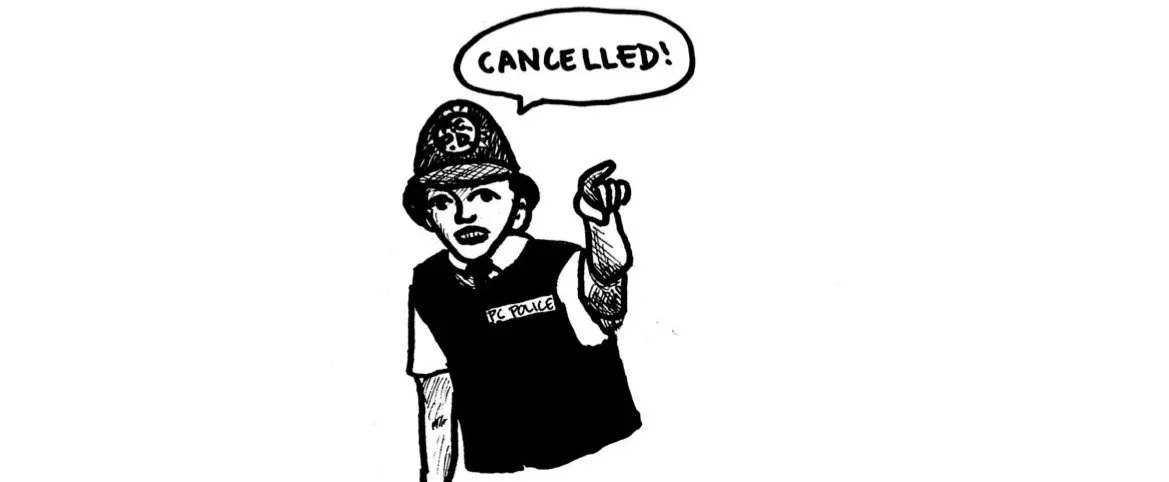
Illustration by Naiya, EIC
Like many people, I chose to come to Oberlin specifically because of its connection to social justice. As the first institution in the U.S. to admit both Black people and women (although still rife with racism and sexism), I felt an affinity toward its politics, history, and ostensibly radical stance regarding the liberation of marginalized peoples. Oberlin famously also housed some of Africa’s most prominent anti-colonial revolutionaries during the struggle for independence; Eduardo Mondlane, Mozambican guerrilla fighter and founder of the Mozambican Revolutionary Front is a prominent example.
When I got here, I quickly realized that my conception of radical politics was rather different from that of the average Obie. Not because I was special (I’m not), but simply because I’d been socialized differently than my peers who grew up in the U.S. Back home, to be “woke” was less about language. It was less about what you wore, what causes you supported, what you reposted on Instagram. At its core was an active (and often dangerous) rebellion against conservative systems which sought to stifle any forms of difference. It was frightening. And usually, it resulted in an incredible amount of pushback. Within my first few weeks here, I learned that being “woke” or “radical” was less about tangible action or liberatory theory, but instead, how one presented themselves to the public: what one said rather than what one did. I conformed expeditiously. Because, well, when in Rome…
Now that I am more confident in my own beliefs, I think it’s exceedingly important that we have this discussion. I started thinking about Oberlin’s brand of wokeness a couple semesters ago after an incident in one of my classes. In a conversation about a movie we had to analyze (for a gay-ass class, mind you), I’d referred to a relationship between a man and a trans woman as queer. Before I could blink, someone’s hand shot up ready to rebuke me. “I think the fact that you’re referring to this connection as a queer one is harmful, because there’s nothing queer about a sexual relationship between a man and a woman,” they said. The insinuation was that because I had called this relationship queer, I was implicitly arguing that the woman in question was not a woman. The insinuation was that I was transphobic. I thought to myself, “The man in this movie quite literally begs the woman to fuck him in the ass. That’s not queer to you?”
Obviously, I didn’t say that. I was enormously flustered, consumed by shame. I stammered and stuttered until the professor changed the topic. For days, it was all I could think about: Am I transphobic? Am I a terrible person? Will I get canceled? What does queer even mean? (Queer, by the way, means a rejection of traditionally binary categories of gender and sex, and a man asking to be fucked in the ass is INDEED queer—I will stand 10 toes down on this). I thought and thought, and the more I thought, the more angry I became. It felt as though this person, so eager to sound smart, so eager to be perceived as perfect, distorted my statement—one which was perfectly reasonable—into something malicious in order to show off their wokeness. I became terrified to speak in class moving forward. I was so afraid to say anything politically incorrect, that I would water down my thoughts, my arguments in a bid to make them as palatable as possible. In letting fear decide what I said or didn’t say, my learning was seriously hampered.
I’ve noticed this a lot here: this weaponization of fear as a tool for conformity. When you sit at the edge of your seat waiting for someone to fuck up, to make a mistake, so that you can correct them in manners that are incredibly dehumanizing and prop yourself up to be the arbiter of morality, you are weaponizing fear. You are making this space unsafe. I also think that “Oberlin wokeness” ™ is one that simultaneously infantilizes and deifies marginalized people. Here’s a controversial take: marginalized people can be pricks too. And it is OKAY to fucking talk about it (to our faces and not on YikYak). Marginalized people are human beings, and when you refuse to say, “hey, that’s not okay” because you think that you will be canceled, or that you will be branded a racist, or a classist, or fatphobic, or transphobic, you are quite literally contributing to the “othering” of people you purport to care so deeply about. You are differentiating them, alienating them, albeit in a distinct way. Of course, the fact that we do not live in a space that allows for kind and critical conversation about certain issues is the primary catalyst of this, I’ll admit. But I also think the power to reshape this space lies in our hands and our hands alone.
Policing language, policing the way people engage with the world, policing people’s comprehension and understanding of particular matters (which, surprise surprise, differs based on people’s cultural context) is so fucking harmful. I want to draw attention to the word “policing” here. Policing is very different from educating. It seems like educating is on the backburner, when it really needs to be the locus of all the interactions we have with one another. Educating looks like, “Hey, why did you say that? Here are the issues I find with your argument or statement,” while policing is the exact opposite: it is the kind of branding and shaming that often occurs here. I know it seems like I complain a fuckton, but it is truly because I love it here. And I want it to get better.
“Woke” is quickly becoming analogous with morality and virtue signaling on our quaint little liberal arts college campus. I think we need to nip that shit in the bud.