By Griffin Larson-Erf, Staff Writer
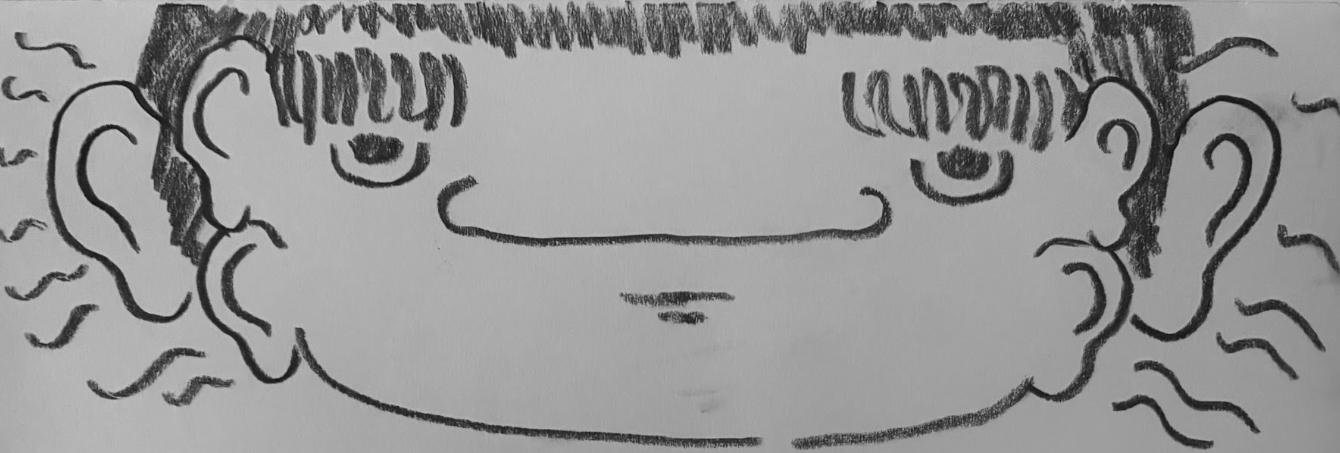
Illustration by Hale Briner, Contributor
It is November 4, around 4 PM, and Finn Saffel Sipes doesn’t know how many people will be here in half an hour. He and I are sitting in a room in Mary Church Terrell Library, waiting for a small group conversation between Oberlin students and radio producer Liza Yeager. Sipes organized the event alongside Lecturer of Cinema and Media Studies David Gutherz, who knows Yeager from previous work together. With Yeager already in town for a November 6 talk, Sipes and Gutherz enlisted her to create an event for their new collective, Radio Arts Workshop (RAW).
RAW provides participants with a place to learn and practice “radio arts.” That term has an expansive definition, Sipes says: he describes it as a type of work with “a focus on storytelling and sound textures.” The label can encompass everything from podcasts to radio plays to soundscapes to Sipes’ own senior capstone project, which used pieces of poetry, animal sounds, and other audio to explore three seemingly disparate topics: “bees,” “human existence as a structure,” and “the idea of the umwelten.”
Sipes recalled first conceiving of the group in the spring of 2026, the same semester in which he graduated. Having been a student of and then a teaching assistant for Gutherz, Sipes and fellow ’26 graduate Francis Gallagher decided to start a student organization dedicated to the kind of work Gutherz had taught them how to do. That semester, he created a proposal for the new organization, while Gallagher began work on a website for it. After further work during the summer, RAW held their first interest meeting on October 1.
So far, the group is only a “vague gathering of people,” Sipes said. “We decide to do a thing, then we send the invite to as many people as we can, and whoever comes to us comes to us.” Beyond Gutherz and himself, Sipes said, about eight people seem disposed to be regular members of the group, which hopes to reach chartered status in Spring 2027.
In contrast to music-oriented campus groups such as Modern Music Guild, RAW “is more for people who are just exploring all the possibilities that are involved with radio, whether that’s audio journalism, or radio arts, or experimental music and soundscapes, or film,” Sipes said. He outlined how, to that end, the group teaches participants how to write for and record different modes of audio storytelling. Moreover, it offers participants a place to seek assistance in completing a piece of work.
Beyond skill-sharing, Sipes described a communal component to RAW—a hope that the group would provide students with a chance to enjoy auditory art in a group, much as they might do for a movie. Not only is sound typically paired with a visual component, and therefore rarely allowed to stand on its own, but few designated physical places are available for experiencing it in the same way that movie theaters are available for films.
Gutherz agreed. “This is basically a historical problem,” he wrote in a November 6 email to the Grape. “There used to be lots of spaces for communal listening. Radio used to be something you [listened to] with your extended family and friends. Greek epics were born from communal listening. Poetry readings happen all the time. We just need to remember how to do [communal listening], and invent new methods to engage people who are used to consuming media through their phones.”
In a November 6 email, Sipes told me that only one person besides them had attended the discussion with Yeager. Nevertheless, he made clear his commitment to making the group happen. “I feel that there is a lot of room for RAW to thrive, we just have to work overtime to lay down a foundation as soon as possible,” he wrote. To that end, Sipes mentioned that he was developing plans for a mass of RAW events later this year.
Meanwhile, in his own email, Gutherz shared his aspirations for the collective, even beyond instruction and community. “I hope that—through this combination of shared listening and collaborative making—RAW can unsettle student expectations about what radio art even is, why we want to make it, and what we want to be listening to on the radio,” he wrote. Come the spring, then, there may be many more Obies with things to say about umwelten and bees.