Interview With Tommy Nickoloff, Director of Jason Molina Documentary
by Ben Rosielle, Contributor
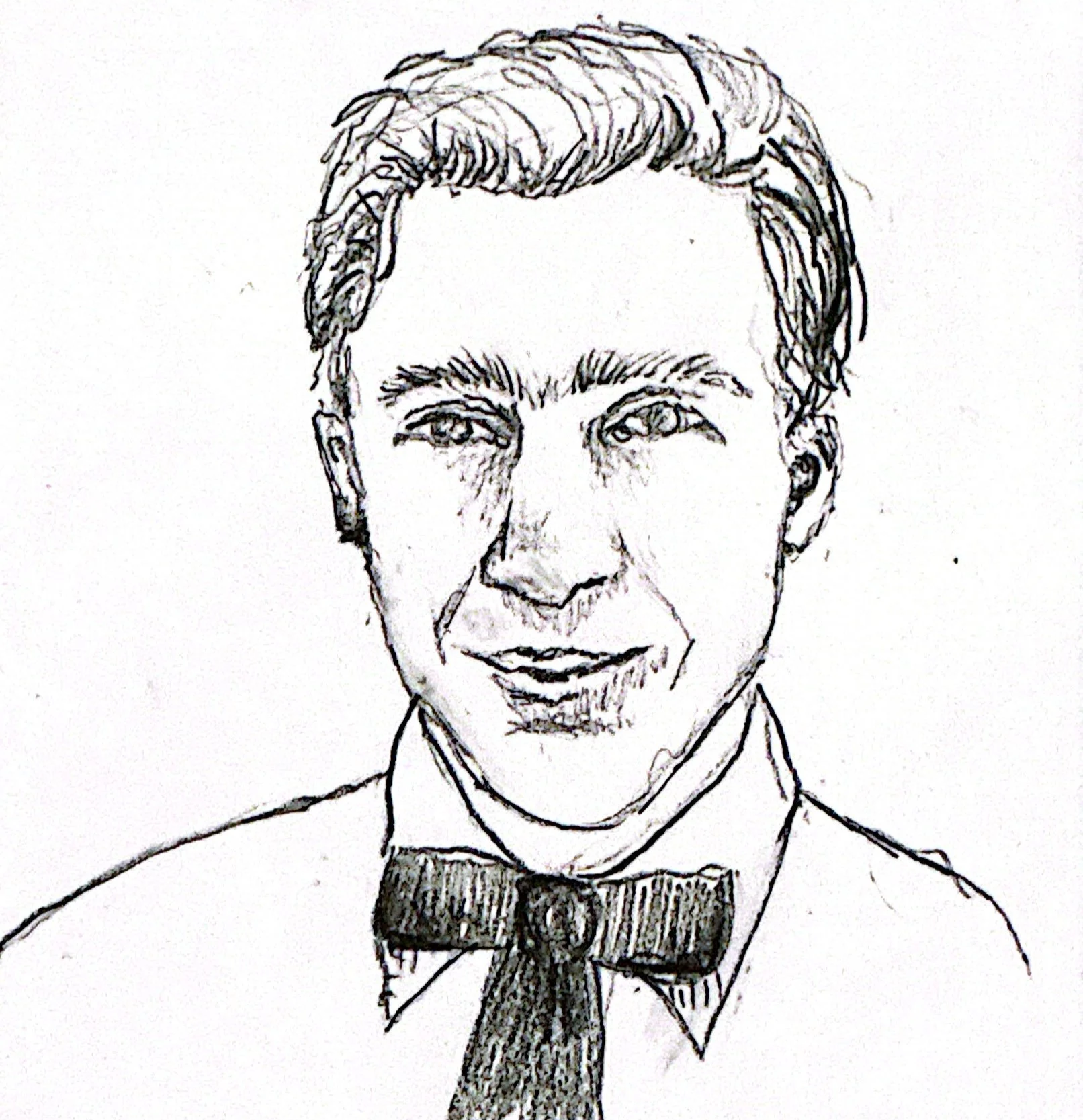
Illustration by Eila Duncan, Layout Editor
Indie rock legend Jason Molina was among Oberlin’s more famous alumni. He grew up in Lorain, with ties to his hometown that reverberated throughout his life, music and career. Molina tragically died of alcohol-related organ failure in 2013, leaving behind an extensive discography and devoted cult following. An upcoming independently-produced documentary on Molina, titled You Fuckers Figure It Out, focuses on his life and career from the perspective of people who grew up or went to Oberlin with him. Director Tommy Nickoloff became friends with Molina in high school, and started work on the documentary in 2021 as a way to honor his legacy and highlight Molina’s connection to his hometown. I had the chance to interview Nickoloff, a first-time director, about the film and the Lorain County community so integral to Molina’s life.
Ben Rosielle: To start us off, do you just want to say a little bit about who you are, and what your connection to Jason is?
Tommy Nickoloff: I was born and raised in Lorain, Ohio. Oberlin and Lorain are very different worlds. I met Jason in 1988. Right around the time we met was when the economy [of Lorain] was really diving to the point where it was noticeable. Lorain was such an industrial powerhouse. It kind of took a little while to realize, “Oh shit, this is going away,” but by the late ’80s, it was becoming recognizable. We were soccer teammates at Admiral King High School. I was a junior, and he was a freshman. Our main gathering point was in a soccer bus, trading cassette tapes and stuff.
BR: How did you get the idea for the documentary?
TN: Jason always encouraged me to be an artist. That was his advice to me, even when he was 14, like, “Just be an artist.” I spent so much of my talent and energy trying to make other people happy and accept me. And he didn't give a shit. Probably from the age of 11 or 12, he knew he was going to pursue art of some kind or another, right? And I never really took that advice. When he died in 2013, that was a huge shakeup in my life and everybody's life that knew or loved him, you know. He was really the only consistent voice that was telling me, “Dude, just be an artist.” When that support was gone, I came to the realization of like, “Oh shit, now it's all up to me.” It took that level of a shakeup to kind of realize like, we're all going to die and we're all going to lose our chance to take a risk and do the things that we want to do. That was 2013, and then eight years later, the Croatian side of my family was doing a family reunion in Lorain. And I shared one of his songs, “Leave the City,” with all my cousins that were coming from the Pacific Northwest and the UK and San Diego and Texas. After I shared that song, my cousin Christie, who's a photographer in San Diego, called me and she goes, “Dude, I knew he was from Lorain, but I didn't know that you knew him, that you guys were friends.” Like I said, he's two years younger than me. So, he graduated with my younger sister Lisa. My ex-wife knew him from the age of three. We have all these friends in common. And so, she [Christie] said, “Why are we not making it? Why aren't we making a documentary on Jason?” That was the moment I decided I was an artist. We started immediately.
BR: From what I can tell by looking at the [YFFIO] website, the city of Lorain and just Lorain County in general play a very big role in the documentary. It kind of seems like you want to bridge this perceived gap between Jason Molina and his hometown, which I think is a place that a lot of outsiders might look down on. How much of that project of bringing him and his music back into that context is the mission of the documentary?
TN: I mean, almost entirely. If any place can use another hero, it's Lorain, Ohio. It's a crazy thing because we have so many of them.
BR: Toni Morrison.
TN: And I feel like they're uncelebrated. Toni Morrison is kind of the only one that really gets her flowers, as she should. I mean, Father Guido Sarducci, who was on the original Saturday Night Live crew. He's from Lorain, Ohio. I don't know how many people know that unless they went to high school with the guy in the ’60s. My uncle, Matthew Yuricich, won a special effects Academy Award for Logan's Run in 1976. Nobody knows that. I have another uncle, Richard Yuricich, who did special effects on 2001 [A Space Odyssey], Close Encounters of the Third Kind, the first Star Trek movie, all the Mission: Impossibles. Nobody knows that. I just moved back in ’22, ’23. Sometimes people limit themselves based on how little they think that other people from their home have done. And that's simply not the case [for Lorain]. Lorain County is 90% of this film. I think an important part of this that I certainly didn't recognize early on, is that, you know, so many people had told me, “Oh, you should pitch this film about the kid that left Lorain, but Lorain never left him,” but the fact of the matter is that he never stopped writing about it. He never stopped writing about Ohio, no matter where he was, you know, he was writing songs with lyrics like “I left what's left of me on the shores of the Erie.” “I’d like to see Ohio one more time before it's gone.” There are all these references, and he's obscure enough of a writer that sometimes they're right on the nose. But if you look for them, whether he intended it or not, you're going to find Lorain County references throughout his catalog.
BR: What has the process of working on the documentary been like?
TN: Best experience of my life. I'm happier than I've ever been, more engaged in my life than I've ever been. I mean, I owe him. Part of the motivation to make the film is because I owe him and now I feel like I owe him even more. From that call with my cousin, Christie Walker, when she said, “Why aren't we making a documentary?” I literally hung up the phone, called Carl Raponi, called Todd Jacops, who went on to play in Songs: Ohia with him, called Mike McCartney, who also played in Songs: Ohia, and just started calling friends that I hadn't spoken to in 20 years. And everybody picked up the phone, and everybody wanted to talk. Within the first hour, there were like five or six people that were like, “Let's make this fucking movie, man.” Geof and Bruce Comings are both Oberlin natives, not college students, like townies. They both played in Songs: Ohia. In fact, after the ’98 tour, Songs: Ohia was just Jason Molina and Geof Comings of Oberlin, Ohio. You know, those guys are my dear friends. I'm sure that we crossed paths, because the old Feve—I love the Feve now—but if you could have seen that place in 1992, holy shit, it was like heaven.
BR: That would have been just when it opened.
TN: Just when it opened, there was nothing like it. There weren't even coffee shops. There was certainly no Starbucks or anything like that. They had pool tables, and people would show up, smoke a pack of cigarettes, drink eight cups of coffee, and see a live band. It was amazing. There was so much talent there. So this is a little after the timeline of the film, but Magnolia Electric Co. which is by most people considered to be Jason's magnum opus. That’s Dan MacAdam, Oberlin College student, Dan Sullivan, also Oberlin College, Jeff Panall, Oberlin College student. A lot of talent came out of there. I mean, no surprise. Jennie, from Jim & Jennie and the Pinetops, Oberlin College student. The first album she's on is Didn’t it Rain. Her voice is amazing, dude. Up until around Didn’t it Rain, it was all Lorain and Oberlin College guys or Oberlin townies, every single person. How does everybody not know that? Isn't that weird?
BR: The first thing about that stood out to me about the documentary was the name: You Fuckers Figure It Out. Is that something Jason said? What does it mean? What does it mean to you?
TN: So this is not an easy undertaking for a lot of reasons, not just for his friends and family, but for his legacy. There needed to be something profound that anchored this film in authenticity to Jason's spirit, in reverence of his spirit. And so that is a quote of his. It's from a chapter in Aaron Osmond's biography on Jason, Riding with the Ghost. It was that Oberlin bunch of guys, Dan MacAdam and Jeff Panall, and they're kind of hounding Jason. Like, “We need a t-shirt for this tour.” Jason hated that stuff. He hated dealing with the marketing and the business. He was a musician. He just wanted to make his music. Everybody else should be handling all the other stuff. So they keep pressuring him about this. And so he just scrawls out a sketch of a t-shirt and writes “you fuckers figure it out” on the t-shirt. And then underneath it, wrote “band t-shirt.” I think it was after Jason died, Dan MacAdam took that post-it note and scanned it and made a t-shirt with a t-shirt on it that says “You fuckers figure it out. Band t-shirt.” That's his quote, but this story doesn't fully explain why it was chosen as a title because Jason simply never explained anything. If he told you a tall tale or a lie, he was never going to give away that it wasn't true, or even confirm whether it was true or not to begin with. He was never going to explain what his songs meant or his lyrics. His approach, not just to music, but to life in general is, “I'm here to do what I do. I did it. Now it's yours. If you have any questions, you fucking figure it out.” Naturally, people have thrown up like, “Oh, this is going to be hard to distribute with the name.” At this stage of the game, I couldn't give less of a shit. It was the flag that we planted to keep this film true to his spirit.