On the Phenomenon of Trans-Fronted Black Metal
by Owen Brandes, Contributor
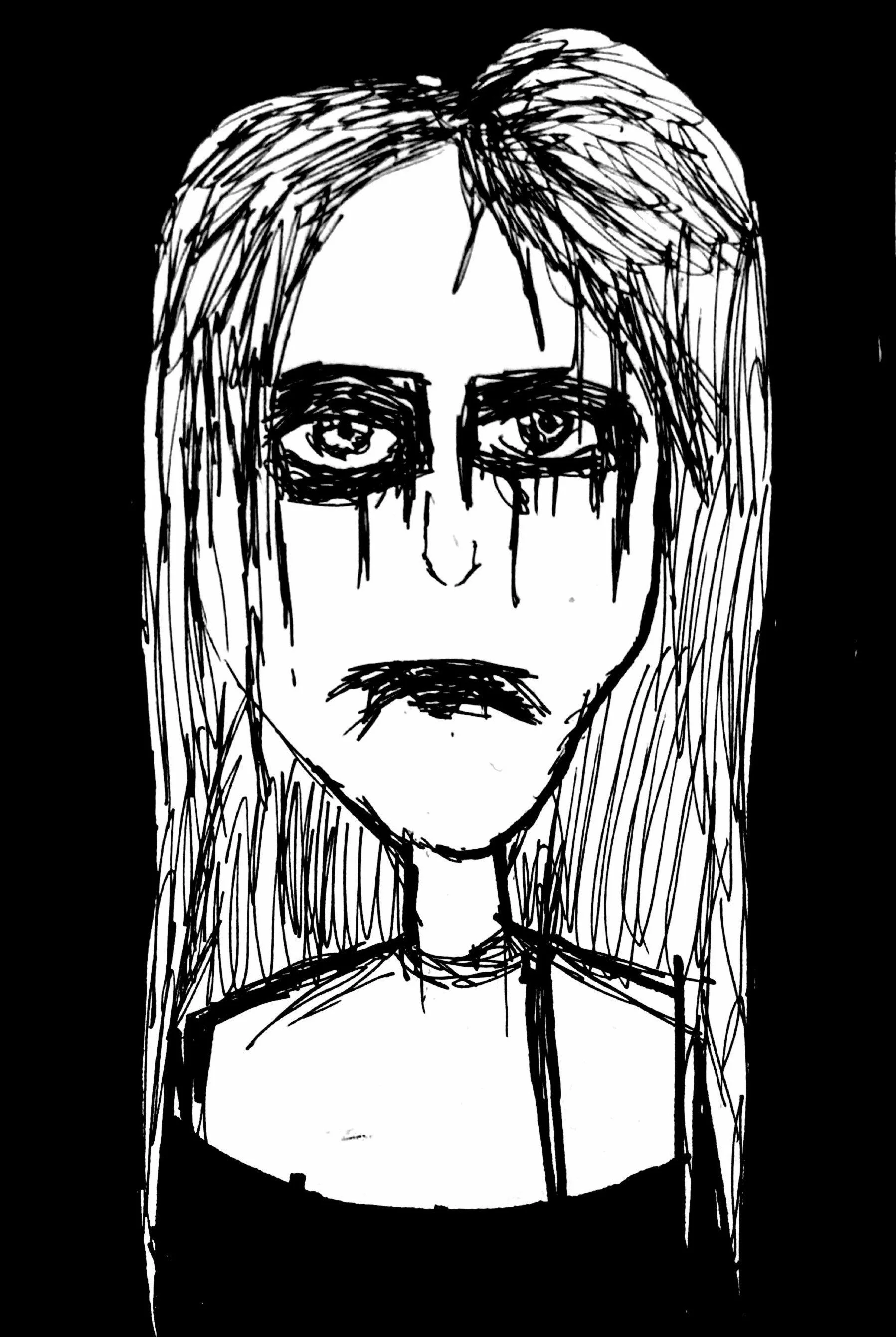
Illustration by Emma Shoaf, Layout Assistant
“I Want to Die Before You” and “Down Titration Strategies” are two promotional singles the multi-instrumentalist Erin Dawson—the “trans Fenriz,” emblazoned on her Bandcamp—has released from her forthcoming album Wellness Plan, a follow-up to 2024’s caustic Chronic Illness Wish, experimental black metal records under Dawson’s project, Genital Shame, which I am a big fan of. I’ll tell you why.
Extreme metal is an intentionally inaccessible musical style, an avant-garde expressionistic form uncompromising in its aesthetic sensibilities, aided and abetted by a subculture similarly peculiar in its customs. Harsh timbral textures from both the instrumentation and the vocals cultivate a severe atmosphere of dread and fright. Black metal in particular often involves a kind of lo-fi aptitude, and a live performance with a definite liturgical quality: corpse paint, spiked clothing, darkness, totems, a whole series of interlinked rituals, with the aim of affirming and reaffirming the cult of the audience and music. It’s a style that depends on dissonances–tonally, visually, historically (a perennial obsession with a fictive imaginary). Yes, it’s weird– sensuously unfamiliar and consequently unappealing. That’s pretty much the whole point, like a lot of weird art.
A brief diversion on weird art: In the early 20th century, modernist artistic aesthetics arose in response to a world swept up by the dual excitement and apprehension of modernity and its myriad social, cultural, political, economic upheavals, prompting a dual abstraction and fragmentation of the “classical” methods and styles– modes of expression rendered in flux, warped, and dynamic, corresponding to a society similarly unstable. Dissonances were central–be they visual, literary, and aural, failing to align with a formalistic orthodoxy. For many, modernity had compelled emotional states that necessitated different kinds of creative sublimation.
I believe (and it’s not just me– probably everyone reading this) we are living through a similar period, of deeply saturated existential uncertainty and terror, the collapse of institutions and structures we are familiar with, the malicious mutation of technology beyond our control, a gnawing apocalyptical feeling, a response to a liquid existence. In response to such profound uncertainty art develops concurrently, transgressing established boundaries and categorization, both a symptom of and balm towards the society that produced it (see feeble little horse’s bitknot).
In popular creative works it is the dissonances, the interstitial discontinuities, and those subsequent possibilities of emotional innovation that I find interest me the most. Often it is the outsider, the marginalized and discounted subject who innovates. Music is a case in point–queer music especially. Ma Rainey in rock n’ roll and the blues, Frankie Knuckles in house, Rob Halford in heavy metal, Freddie Mercury and David Bowie in glam and art rock, Wendy Carlos in electronica. I think the same is the case for (at least some of the) the most sonically polarizing—and consequently exciting—music today, extreme metal.
Now, extreme metal—black metal in particular—is tricky. The subgenre is infamous for the 1990s Norwegian scene that was essentially a reactionary musico-cultural phenomenon headed by a bunch of Tolkien-obsessed, Satan-worshipping teenagers that, in their cloistered inceldom, perpetrated a series of church burnings and murders (that “Fenriz” name up above is the musician behind the project Darkthrone, a key band in the scene that mostly avoided all the insanity). But, as these sorts of things often go, they still pioneered a really compelling, really sonically audacious and coherent kind of art. In comparison I often think of the Italian Futurists in the early twentieth century, avowed modernists so inflexible and unyielding in their aesthetic convictions that they all goose-stepped their way into Mussolini’s fascist regime.
That’s all pretty inexcusable; black metal continually reckons and reconciles with its past. But as it so happens those bands making the best kind of black metal, or death metal, or sludge or doom or grindcore or whatever (really any kind of music) nowadays are not those retreating into a reactionary ideological and aesthetic mind palace. It’s those projects progressing, not regressing. And as it also so happens, those on the musical fringe of this musical fringe are doing the most (also indigenous American black metal, but that’s a whole other article), as they often do.
All this being said, long ruminations on aesthetics and music and history and politics aside, at the very least, basically I think more people should give extreme metal a chance because it may embody a feeling about yourself or the world that you—yes, you!—have not been able to communicate or express elsewhere, something very intimate and subtle and strange. Strange art for strange times. It may be a bit relieving in a way, who knows? For me it certainly is. Consider overcoming alienation from yourself and others by trying out some Genital Shame for a change. I’m excited for Wellness Plan.
Some more trans-fronted black metal:
Liturgy – H.A.Q.Q. (2019)
Agriculture – Agriculture (2023)
Lust Hag – Lust Hag (2024)
Turpitude – Mordoré (2026)
Body Void – Ruins (2017)