by Sloane DiBari, Opinions Editor
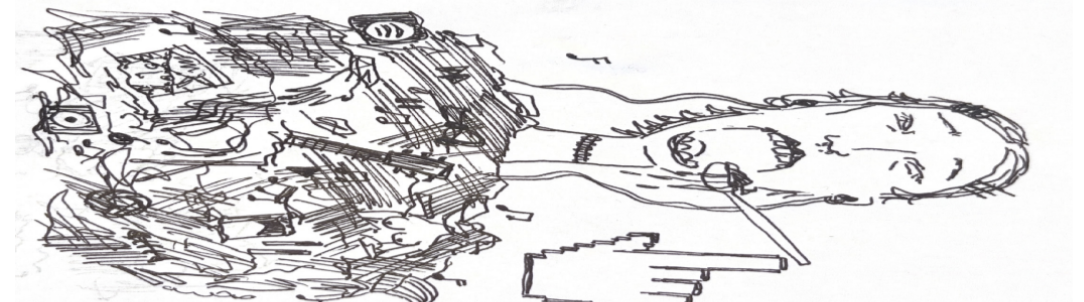
Illustration by Anna Scales, Contributor
Surely everyone can agree that we’re living in the Slop Age. In 2025, Merriam-Webster named slop the Word of the Year, defined as “digital content of low quality that is produced usually in quantity by means of artificial intelligence.” In the cultural consciousness, it’s taken on a number of other meanings: slop could mean anything that is boring, overstimulating, or just doing too much.
In this second installment of my careful taxonomy of Gen Z music, I wanted to propose a nuanced understanding of “slop” as not just music that is bad, nor music that is soulless, nor low-effort, nor mass-produced by generative AI. Instead, I wanted “slop” to encompass both that grotesque digital sludge and music which seeks, or seems to seek, to be a distinct artifact of the Slop Age. Because the word “slop” usually connotes, well, horrible, mindless crap, I’ve devised an imperfect term in response: “indieslop,” music which wields Slop Aesthetics and Slop Artifice with keen intentionality. (Note that I may correct this term later on in my catalog.)
For those who didn’t catch Pt. 1 in December: “Zoomer/Gen Z Music” is here defined as music made primarily by people born between 1997 and 2012 (with a few exceptions for those whose ages aren’t public or who are on the Millennial/Gen Z cusp), released no earlier than 2019, and whose sounds and/or attitudes are distinct from those of other generations; impersonation acts like Greta Van Fleet and whatever don’t count. Most categories will have significant overlap of sounds and artists; eclecticism and boundary-blurring are the name of the game.
I can’t even begin to do the vast, dystopian, atrocious, beautiful world of indieslop justice in the space of a Grape article, but here are two important subcategories to start.
iPad Kid Dance Music is like if Instagram Reels were a music genre (or a collection of them?), but in a cool, subversive, respectable way. In the early 2020s, a number of young, ultra-online musicians began taking a bunch of slop, chopping it up, and splicing it all together in a tacky yet far from artless manner. The results of these early Slop Age experiments most notably include dariacore. Pioneered by teenaged bedroom producer leroy (now more commonly known as Jane Remover) toward the beginning of the decade, dariacore blends disparate dance music influences and incorporates recognizable samples from TV, film, games, YouTube videos, pop music, and every other imaginable mode of pop culture. Throwing everything from infamous YouTuber blunders to Azealia Banks’ finest work into the mix, leroy popularized incorporating internet slop into Real Actual Pop Culture. In the following years, slop became more of a fixture in extremely online hip hop and electronic music; producers like Galactic Hole began to sound like YouTube Poops carefully arranged into something that’s actually music that’s actually pretty good. Today, for better or for worse, it seems that a number of niche internet microgenres (jerk, sigilkore, etc.) have fallen head over heels in love with the art of slop-repurposing, appealing not to the miserable doomscroller but to the hyperentertained iPad Kid in all of us.
Two Defining Songs: …during pride month? – leroy, 2:67 AM – Galactic Hole
Slopadelia is my brilliant colleague/preeminent internet music scholar Ben Rosielle’s riff on the idea of “brainrot psychedelia” articulated by jc grame, leader of the micro-influential online music-philosophy-furry (???) collective friends&. (Rosielle clarifies that brainrot psychedelia is “far more pretentious and widespread than slopadelia”—slopadelia is a more basic, easier to understand synthesis of brainrot psychedelia.) Slopadelia distills the unreality of being constantly overloaded with bizarre, disturbing, stupid, evil, brain-melting shit on our social media feeds into a sonic form, but it adds an extra layer to iPad Kid Dance Music’s aesthetic concerns: slopadelia isn’t just self-aware or post-ironic or whatever, it’s elevated. friends& is leading a growing movement of straight-up slop scholars who deftly weave together things like spoken Mark Fisher/Deleuze and Guattari quotes, Bob Dylan compositions, memes, and, uh, AI-generated Jeff Mangum vocal samples (??????). Grame and co.’s recently released magnum opus folx features perhaps the most expansive liner notes I’ve ever come across, song titles of migraine-inducing length and format, and an impossible patchwork of disparate fragments of culture, philosophy, art, and the internet. It situates beats any normal person can dance to alongside samples of tracks only people who spend a religious amount of time on RateYourMusic could ever hope to identify. This is the kind of music that drives it home to people like me that we’re not actually on the cutting edge; we know it’s new and interesting and innovative, but it just tires us out. But maybe that’s the point.
Two Defining Songs: Just listen to folx for, like, five minutes.